A Winter Garden Walk for Shape and Silhouette
A winter garden walk reveals plant outlines, repeated forms, and open spaces, helping you spot where spring growth may clarify or crowd the design.
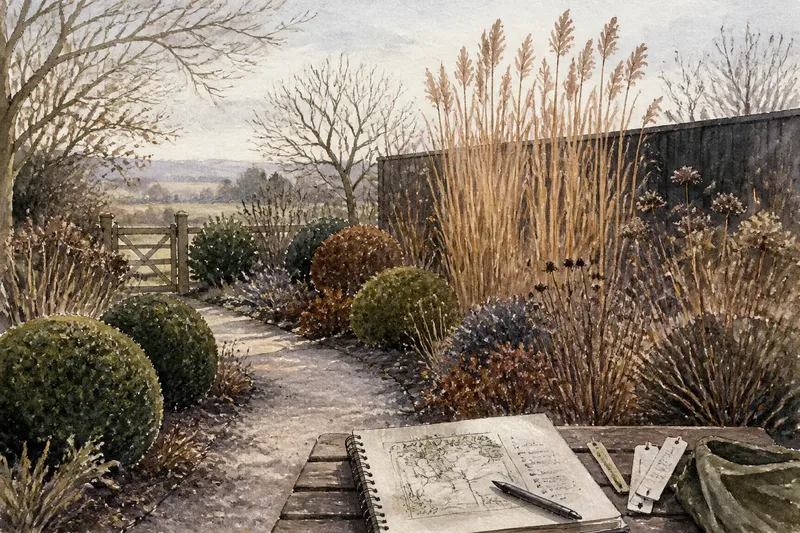
On a bare winter morning, a garden can look less like a collection of plants and more like a drawing: dark stems against pale sky, rounded shrubs beside upright grasses, and gaps that summer foliage hides. A winter garden walk lets you read those shapes before new growth blurs them, so you can decide what the garden needs rather than pruning simply because the beds look empty.
The aim is not to make a long maintenance list. Walk slowly, notice what repeats, and mark only the places where a shape feels unclear, crowded, or unexpectedly useful. Keep a notebook, a phone for photographs, and a few loose plant labels or flags. Leave pruners in the shed for this first pass.
Where should you begin the winter garden walk?
Start at the place you most often enter or look out from: a back door, kitchen window, gate, or path junction. Stand still and take in the whole view before moving closer. This first glance captures the garden as a composition, with its tallest points, low edges, and visible openings.
Then walk the same route a visitor might take. Look from several fixed positions rather than circling each bed at random. A tall plant may seem graceful close up but block a view from the gate; a bare patch may look empty from the house yet provide a useful pause beside a path.
At each stopping place, note three things: the strongest outline, any form repeated elsewhere, and the largest open area. A quick sketch is enough. Use arrows for direction and simple shapes for shrubs, grasses, fences, and trees; exact botanical detail is not needed.
Which outlines deserve a closer look?
Notice how plants hold their form after leaves fall. A multi-stem shrub makes a different mark from a single trunk. Upright ornamental grass can echo a narrow tree, while a spreading evergreen can anchor a low corner. Seed heads and sturdy stems may add fine texture, but they should not distract from the larger structure.
Look for repeated forms across the garden. Repetition can link separate areas: a pair of rounded shrubs, several upright clumps, or a recurring arch of branches. It need not be exact. Similar heights or outlines can create a visual rhythm, while a single contrasting shape gives the eye somewhere to pause.
Also check where outlines collide. A shrub may merge visually with a fence, or bare branches may cross a window view. Before deciding that one plant is the problem, shift a few steps to see whether the overlap changes. Sometimes the issue is the viewing angle, not the planting.
What do the open spaces tell you?
Read the gaps as carefully as the plants. An opening between shrubs might draw the eye toward a bench or a distant tree. A clear patch beside a path can keep the route legible. By contrast, a wide blank stretch may make a border feel disconnected if there is no visual link across it.
Ask whether each open area looks deliberate from the viewpoints you recorded. If it does, protect it from the urge to fill every patch. If it seems accidental, note what kind of form might connect the surrounding shapes, but do not choose a plant on the spot. The best answer may be a different position for an existing plant, a clearer edge, or simply leaving the gap alone.
Say you have an invented, hypothetical garden where a rounded evergreen sits near the path and tall dried grasses stand at the far end. From the kitchen window, the grass tops align with a dark fence and disappear; from the gate, they make a clear upright accent. You could mark both viewpoints, then wait until spring growth appears before deciding whether to thin the planting or keep the contrast. The observable result of that pause is a better comparison: you can see whether the original outline remains legible as new leaves arrive.
How can you record what you see without overplanning?
Use a small map with three simple marks: a circle for rounded forms, a line for upright forms, and an open bracket for a gap you want to preserve or reconsider. Add a short note beside each mark, such as “visible from gate” or “crowds window view.” This records the design question without pretending to settle it.
- Mark the viewpoint and direction of each useful photograph.
- Circle repeated outlines that help connect separate beds.
- Underline shapes that vanish against a fence or hedge.
- Draw a boundary around openings that make a path or view feel clear.
- Flag possible changes for review after spring growth, rather than cutting now.
Photographs are most useful when taken from the same positions each time. A photograph of one branch close up may help identify a plant later, but it says little about how that plant relates to the rest of the garden. Keep the wider frame, and add a closer image only when a particular outline needs attention.
What questions help turn the walk into a useful plan?
Should I prune a shrub because its outline looks untidy?
Not on the basis of one winter view alone. Record what bothers you and check the plant’s needs and timing before making a cut.
Are dried stems part of the garden’s structure?
They can be, especially when their upright forms repeat or catch light against a darker background. Notice whether they contribute to the overall silhouette or merely obscure a stronger shape.
How do I tell a useful gap from a bare patch?
Compare it from more than one viewpoint and consider what it reveals or separates. A useful gap clarifies a route or view; an unresolved patch tends to interrupt the pattern without giving the eye a destination.
When should I revisit the notes?
Return after spring growth has made the main outlines visible again. Compare the same views, then decide whether the winter concern persisted or whether foliage naturally softened it.
What is not worth the effort on this walk?
Do not try to identify every twig, measure every gap, or sketch each bed to scale. Those tasks can consume the walk without improving the design decisions. A few clear observations tied to real viewpoints are more useful than a detailed record you will not consult.
Keep the winter garden walk focused on shape, repetition, and space. Its notes should help you see what the garden already communicates and where spring growth may alter that message. When you revisit the same viewpoints, the winter garden walk becomes a practical way to judge the outlines you noticed before growth returned, without turning every quiet corner into a project.