Why a Seedling Leans Toward the Window
Learn why a seedling leans toward the window and how gradual pot rotation can encourage balanced growth without disrupting its light or care.
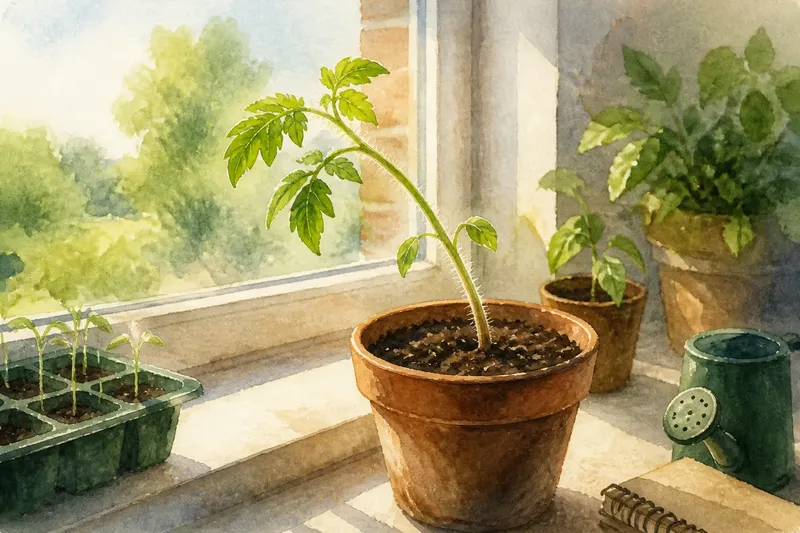
Why does a seedling lean toward the window, even when its pot sits upright on a level sill? The usual reason is that light reaches it more strongly from one direction, so the young stem grows toward that brighter side. Understanding this response makes it easier to decide when to rotate the pot—and when a lean signals a different problem.
What makes a seedling bend toward light?
A growing shoot responds to the direction of light. In a room, the window is often the brightest part of the plant’s surroundings, while the wall and the interior of the room are comparatively dim. As the seedling grows, its stem curves toward the stronger light. This directional growth is called phototropism.
The bend develops in the growing part of the shoot. It is not the pot shifting or the roots pulling the plant sideways. A young stem can change its direction of growth, so the newest section gradually points closer to the light source. The bend may be subtle at first and more obvious after several days of growth.
Outdoor light usually comes from a broad expanse of sky, though a fence, hedge, or nearby building can shade one side. Indoors, a single window creates a more distinct bright side. That difference is why a windowsill seedling may curve noticeably even if it is otherwise healthy.
Does a leaning seedling need help?
A gentle lean toward the window is a normal response, not automatically a sign of disease. If the stem is firm and the plant is making new leaves, the curve may simply show where the light is coming from. A small turn of the pot can encourage the next growth to develop from a different direction.
A pronounced lean can also mean that the seedling is not getting enough light overall. In dim conditions, it may stretch as it grows, with a long, thin stem and widely spaced leaves. Turning the pot changes which side faces the window; it does not add light. If the plant keeps stretching, consider moving it to a brighter suitable location or using an appropriate grow light according to its instructions.
Check the stem and growing mix before assuming light direction is the only issue. A soft, pinched, or collapsing stem can point to a problem such as excess moisture or disease rather than ordinary bending. A pot that rocks or leans because the mix has shifted also needs a different remedy. For plant-specific care, follow the seed packet or other reliable growing instructions.
How should you rotate a seedling’s pot?
Rotate the pot a little at a time, then give the seedling an opportunity to grow in its new orientation. A half-turn is not necessary every time: a modest turn can bring a new side toward the window without repeatedly changing the plant’s surroundings. Use the same familiar reference point, such as the side of the pot facing the glass, so you can tell which direction you turned it.
- Start with a stable pot on a level surface, away from a spot where it could be knocked.
- Turn it gently rather than twisting the stem or tugging at the leaves.
- Keep the plant at a similar distance from the window after turning.
- Check the leaves and stem over the next few days before deciding whether another turn is useful.
- Keep watering and other care consistent while you observe the change, so you can judge the effect of light direction more clearly.
Say you have a tomato seedling whose newest leaves face the glass while its stem curves toward the window. You turn the pot modestly so the curved side faces farther into the room, leaving the plant in the same bright spot. The new section of stem may then grow in a direction that makes the overall shape look less one-sided. The existing curve will not necessarily straighten, because the older stem does not simply reverse its growth.
How often should you turn the pot?
There is no single schedule that suits every seedling or window. The useful cue is the plant’s growth: if new growth repeatedly angles toward the glass, a gentle turn can help distribute that direction over time. If the seedling is growing upright and evenly, frequent rotation adds little.
Look at the plant from the side as well as from above. A top view may make the leaves seem balanced while the stem continues to arc. Marking the window-facing side of the pot with a small piece of removable tape can help you remember its orientation without marking the plant.
Rotation works best as a small adjustment, not a substitute for a suitable growing position. Avoid moving a seedling back and forth between very different light conditions just to make it face another way. Sudden changes can add stress, and the plant may respond to the new setting rather than to the turn itself.
Why can a seedling still look lopsided?
Light direction is only one influence on shape. A nearby wall, another plant, or a curtain can block light from one side. The leaves may also overlap as they emerge, making the seedling look uneven even when its stem is growing normally. Clear a small amount of space around it if neighboring objects cast a persistent shadow.
Water and temperature can affect how well a seedling holds itself upright, too. A dry growing mix may leave a plant limp, while consistently wet conditions can damage roots or weaken growth. Check the moisture in the mix rather than watering merely because the stem has a curve. A leaning plant does not, by itself, tell you whether it needs water.
Some seedlings naturally develop a more open or asymmetric form than others. The first leaves may face one way while later leaves arrange themselves differently as the plant grows. For crops or flowers that will soon be planted outdoors, a slight indoor lean may matter less than a healthy, sturdy stem and appropriate conditions for planting out.
What should you avoid when correcting a lean?
Do not try to force the stem straight by pressing it against the pot rim or bending it with your fingers. Young stems can be delicate, and a mechanical bend may cause damage without changing the direction of later growth. A stake is not usually needed for a small, healthy seedling simply because it leans toward a window.
It is also not worth rotating the pot several times a day or chasing a perfectly symmetrical outline. A little asymmetry is ordinary, and constant repositioning makes it harder to see whether a change in light or care is helping. Turn the pot gently, then let the seedling grow before making another adjustment.
What else do gardeners ask about a leaning seedling?
Will rotating the pot straighten the bent part of the stem?
Rotation changes which direction the growing shoot faces; it does not reliably erase a curve already formed. With steady light and gradual turns, later growth may make the plant appear more balanced.
Should every indoor seedling be rotated?
No. Turn a pot when the plant’s new growth keeps leaning toward a one-sided light source. A seedling that grows evenly in bright, suitable light does not need a rotation routine.
Can I rotate a seedling under a grow light?
If the light is positioned above the plant and reaches it evenly, rotation may be less useful. If the grow light illuminates it from one side, use its instructions to set the placement and adjust the pot gently if growth keeps angling toward the source.
When is a lean a reason to investigate further?
Look more closely if the stem is weak, damaged, or collapsing, or if the seedling is stretching with sparse leaves. Check light, moisture, and the growing mix rather than treating every lean as a simple directional response.
How can you judge whether the adjustment is working?
Watch the newest growth, not just the oldest bend. If fresh leaves and stem sections develop in a less one-sided direction while the plant remains firm, your placement and occasional turns are likely serving their purpose. If it continues stretching or weakening, address the growing conditions instead of increasing the rotation.
For a seedling that leans toward the window, the most useful first move is usually a calm one: identify the brighter side, turn the pot gently if needed, and observe the next growth. Keep the plant in a suitable light position, and let its new stem show whether the adjustment is helping.